Introduction
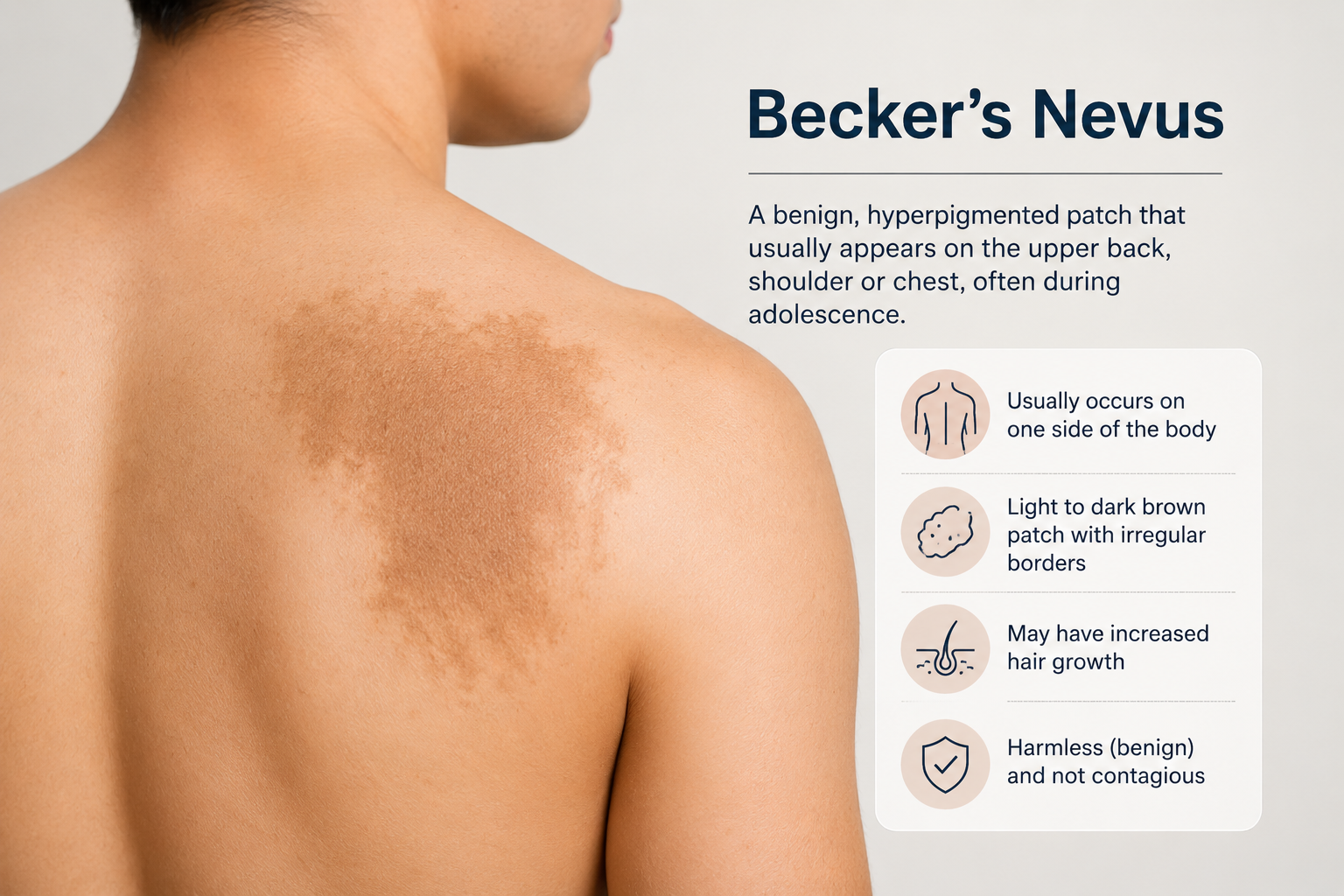
Becker’s nevus is a benign cutaneous hamartoma characterized by a unilateral, well-defined hyperpigmented patch that most commonly develops over the shoulder, upper chest, upper back, or upper arm. The lesion often becomes more noticeable during adolescence and may gradually develop coarse terminal hair (hypertrichosis) and mild skin thickening. Although Becker’s nevus occurs more frequently in males, it can also affect females, in whom excess hair may be minimal or absent.
Despite its striking appearance, Becker’s nevus is considered a benign condition with an extremely low risk of malignant transformation. For most individuals, it represents a cosmetic concern rather than a medical disorder.
Why Does Becker’s Nevus Occur?
The exact cause remains incompletely understood. Current evidence suggests that Becker’s nevus results from cutaneous mosaicism, a developmental phenomenon in which a localized population of skin cells differs genetically or epigenetically from the surrounding skin.
The affected skin also demonstrates increased sensitivity to androgen hormones because of enhanced androgen receptor expression. During puberty, when circulating androgen levels naturally rise, these androgen-sensitive skin cells respond more prominently, leading to increased melanin production, mild epidermal thickening, and, in many cases, excessive hair growth within the lesion.
Clinical Features
Typical features include:
A unilateral, well-defined brown patch.
Most commonly located on the shoulder, upper chest, upper back, or upper arm.
Gradual enlargement during adolescence.
Increased coarse hair (hypertrichosis) in many individuals.
Mild thickening of the skin in some cases.
Usually asymptomatic without pain or itching.
Although most lesions develop around puberty, rare congenital cases have also been reported.
Is Becker’s Nevus Dangerous?
No.
Becker’s nevus is considered a benign skin lesion with no significant malignant potential. It does not usually progress to skin cancer and generally does not affect overall health.
In uncommon cases, Becker’s nevus may occur as part of Becker’s Nevus Syndrome, in which the skin lesion is associated with abnormalities involving the breast, skeletal muscles, or underlying bones. Individuals with suspected associated abnormalities should undergo appropriate medical evaluation.
Diagnosis
Diagnosis is usually made through clinical examination by a dermatologist.
When the diagnosis is uncertain, dermoscopy or a skin biopsy may be performed to distinguish Becker’s nevus from other pigmented skin lesions.
Treatment
Treatment is generally unnecessary because the lesion is harmless.
For individuals concerned about its cosmetic appearance, treatment options may include:
Laser hair removal for excessive hair growth.
Pigment-reducing laser therapies to partially lighten the lesion.
However, Response to treatment varies, and complete clearance is uncommon.
Conclusion
Becker’s nevus is a benign cutaneous hamartoma that typically appears during adolescence as a unilateral hyperpigmented patch, often accompanied by increased hair growth. The condition is believed to result from cutaneous mosaicism and increased local androgen receptor sensitivity. Although it may become darker or hairier during puberty, it has no significant malignant potential and usually requires only reassurance. Treatment is primarily cosmetic and should be individualized according to the patient’s concerns.
References
Lookingbill DP, Marks JG. Lookingbill and Marks’ Principles of Dermatology. 7th ed. Elsevier; 2024.
British Association of Dermatologists. Becker Naevus: Patient Information Leaflet. Updated 2025.
Desai S, Cohen PR. Becker Nevus Syndrome: A Rare Entity. J Clin Aesthet Dermatol. 2019;12(11):35–37.
Bolognia JL, Schaffer JV, Cerroni L. Dermatology. 5th ed. Elsevier; 2024.