Introduction
Stretch marks, medically known as striae distensae, affect millions of individuals worldwide. They commonly develop during pregnancy, puberty, rapid weight gain, obesity, rapid muscle hypertrophy, and prolonged corticosteroid exposure. Despite being one of the most common dermatological conditions, they remain one of the most misunderstood. Social media advertisements frequently claim that a particular oil, serum, or cream can completely erase stretch marks within days or weeks. Such claims rarely reflect the underlying biology of the skin.
To understand why these products fail to permanently eliminate stretch marks, it is important to first understand the structure of the skin and where the actual damage occurs.
Understanding the Anatomy of Stretch Marks
Human skin consists of three major layers.
The epidermis is the outer protective barrier that protects against pathogens, ultraviolet radiation, and excessive water loss.
Beneath it lies the dermis, the structural layer composed predominantly of type I and type III collagen fibers, elastic fibers, fibroblasts, blood vessels, nerves, hair follicles, and sweat glands. This layer provides the skin with tensile strength, elasticity, and structural support.
Below the dermis lies the hypodermis (subcutaneous tissue), which mainly contains adipose tissue and connective tissue. Beneath the hypodermis are the underlying muscles.
During pregnancy, rapid weight gain, puberty, or rapid muscle enlargement, the underlying tissues expand rapidly. This mechanical expansion places excessive tensile stress on the dermis.
What Actually Happens During Stretch Mark Formation?
Contrary to popular belief, the epidermis does not tear.
Instead, excessive stretching causes the collagen and elastic fibers within the dermis to undergo microscopic disruption, fragmentation, and remodeling. Histologically, the dermis becomes thinner, weaker, and loses its normal organized collagen architecture. The epidermis generally remains intact but may become mildly atrophic (thinner), making the damaged dermis beneath more apparent.
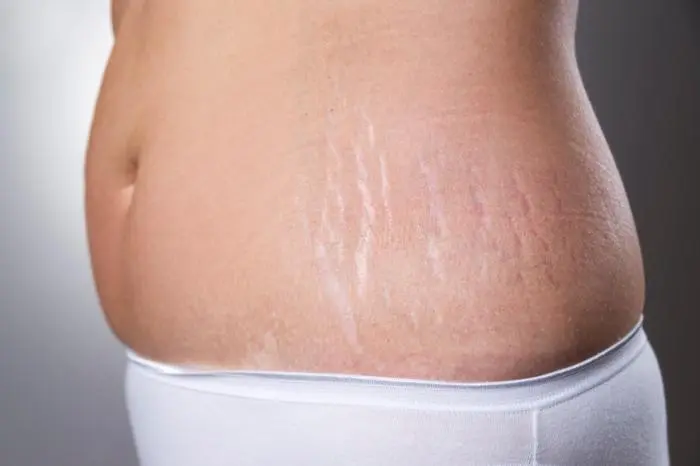
Early stretch marks, known as striae rubrae, appear red or purple because inflammation and increased visibility of dermal blood vessels contribute to their color. As inflammation subsides and scar remodeling occurs, they gradually become pale, depressed, and hypopigmented, forming striae albae.
Therefore, stretch marks are fundamentally dermal scars, not superficial skin injuries.
Common Myths About Stretch Marks
One of the most common misconceptions is that stretch marks occur because the outer layer of the skin tears. Scientifically, the primary damage occurs within the dermis, while the epidermis remains largely intact.
Another widespread belief is that almond oil, olive oil, cocoa butter, shea butter, vitamin E oil, or similar natural products can regenerate damaged skin. While these products may moisturize the outer layer of the skin and temporarily improve its appearance, they cannot reconstruct the disrupted collagen and elastic fiber network within the dermis.
Many advertisements also promise complete removal within days. In reality, stretch marks naturally become less noticeable over months or years, and differences in lighting, camera angle, skin hydration, and image editing may exaggerate apparent improvements shown in promotional materials.
Do Natural Remedies Work?
Natural remedies commonly promoted include:
* Almond oil
* Olive oil
* Coconut oil
* Cocoa butter
* Shea butter
* Vitamin E oil
* Aloe vera
* Castor oil
* Coffee scrubs
Current scientific evidence indicates that these products primarily improve skin hydration and may reduce dryness or itching. However, there is no convincing evidence that they regenerate damaged collagen and elastin fibers within the dermis or completely eliminate stretch marks.
What Treatments Have Scientific Evidence?
Although no treatment can completely restore the dermis to its original structure, several interventions may improve the appearance of stretch marks.
For early red stretch marks (striae rubrae), topical tretinoin has demonstrated improvement in collagen synthesis and may improve appearance. However, tretinoin should not be used during pregnancy because of potential fetal risk.
For established white stretch marks (striae albae), fractional CO₂ laser, fractional Er:YAG laser, microneedling, and radiofrequency microneedling have shown the strongest evidence for stimulating dermal collagen remodeling and improving skin texture.
Platelet-rich plasma (PRP) may provide additional benefit when combined with microneedling, although current evidence remains variable and further high-quality studies are needed.
These treatments improve scar remodeling rather than completely regenerating normal dermal architecture.
Why Most Stretch Mark Creams Fail
Most commercially available stretch mark creams are applied only to the epidermis, where their primary effect is to moisturize the superficial skin barrier.
Because stretch marks result from microscopic structural damage within the dermis, simply hydrating the epidermis cannot rebuild the disrupted collagen and elastin network. Consequently, while moisturizers may temporarily improve skin texture and make stretch marks appear less noticeable, they cannot reverse the underlying structural damage.
This explains why no topical cosmetic product has been scientifically proven to completely erase stretch marks.
Conclusion
Stretch marks are a natural biological consequence of rapid skin stretching and hormonal influences. They develop because the collagen and elastic fibers within the dermis undergo microscopic structural damage and remodeling. The epidermis remains largely intact, while the underlying dermal changes become increasingly visible.
Moisturizers, oils, and cosmetic serums may improve skin hydration and temporarily enhance appearance, but they cannot regenerate the damaged dermal collagen network. At present, no scientifically validated topical product can completely eliminate stretch marks. Evidence-based procedures such as microneedling and fractional laser therapy may significantly improve their appearance, but complete restoration of normal skin architecture remains beyond the capabilities of current medical science.
References
1. Oakley A, Patel BC. Striae Distensae (Stretch Marks). StatPearls Publishing. Updated 2025.
2. Ud-Din S, McGeorge D, Bayat A. Topical management of striae distensae (stretch marks): Prevention and therapy of striae rubrae and striae albae. J Eur Acad Dermatol Venereol. 2016.
3. Elsaie ML, Baumann LS, Elsaaiee LT. Striae distensae (stretch marks) and different modalities of therapy: An update. Dermatol Surg. 2009.
4. American Academy of Dermatology Association. Stretch marks: Why they appear and how dermatologists treat them. Updated 2024.